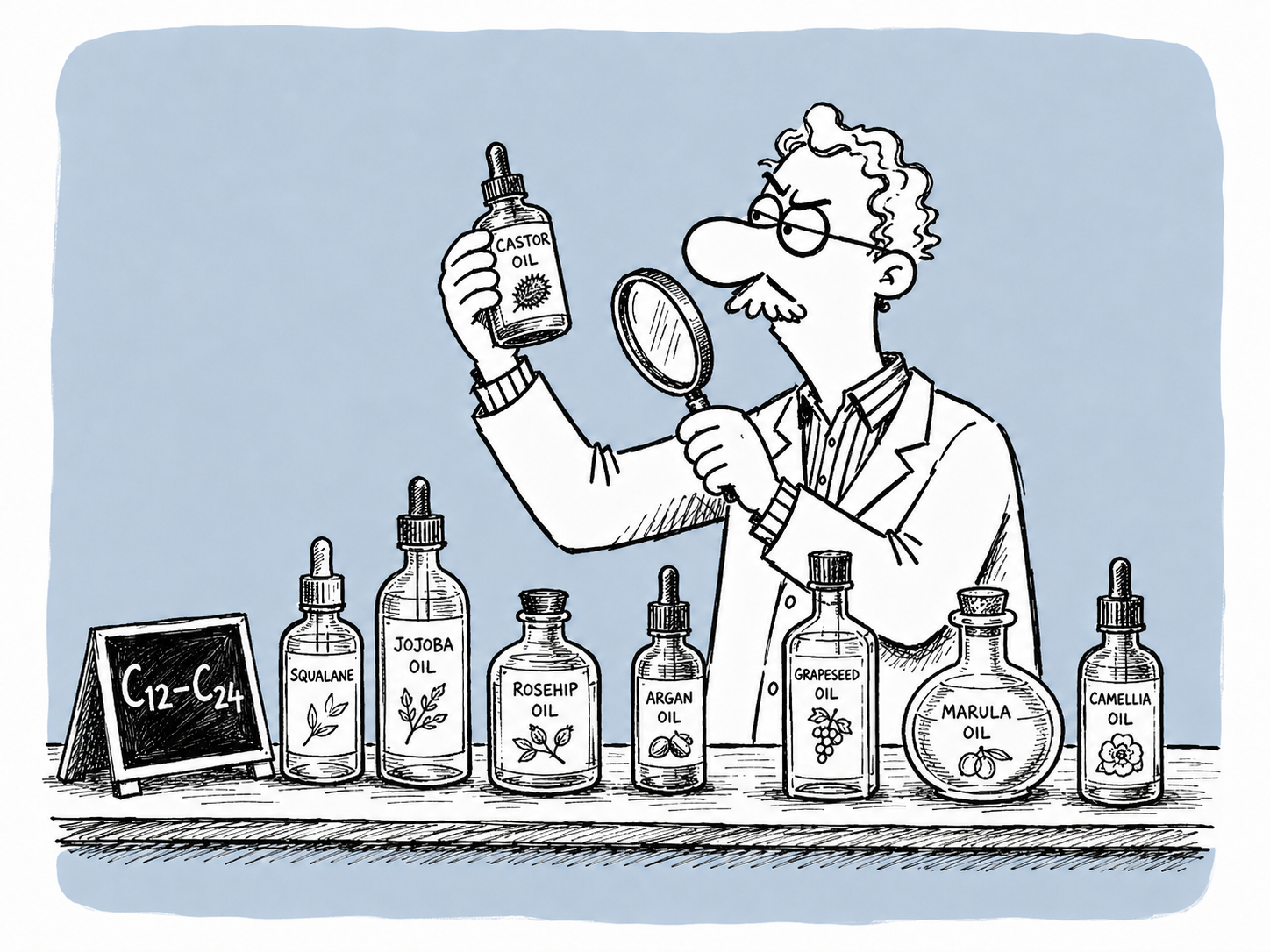
Why Your Moisturizer Is Feeding Your Fungal Acne
Is This Post For You?
- You’ve switched moisturizers multiple times and keep breaking out in small, itchy bumps
- Your skin does better with gel formulas than with creams or face oils
- You’ve tried “clean beauty” oils — rosehip, marula, argan — and your skin got worse, not better
- The bumps are uniform in size and tend to cluster on the forehead, hairline, or jawline
- You’ve never had someone explain why one moisturizer destroys your skin while another is fine
- You want to read an ingredient label and actually know what to look for
You did everything right.
You researched. You read the reviews. You paid $68 for a cold-pressed, unrefined face oil with a four-star average and six hundred glowing testimonials. “Holy grail,” said one. “Finally fixed my skin barrier,” said another.
Four days later, your forehead was covered in tiny, itchy bumps.
You switched to a different oil. Same result. A third. Same. Your bathroom cabinet became a graveyard of half-used bottles — each one promised hydration, each one delivered a breakout. The people recommending them — beauty editors, dermatologists on TikTok, your friend with luminous skin — all seemed fine.
You assumed something was wrong with you.
There isn’t. The oils aren’t bad. Your skin is doing exactly what it’s supposed to do. The problem is that Malassezia — the yeast that causes fungal acne — is eating your moisturizer. And nobody thought to tell you that before you spent $200 finding out.
The Structural Problem: Why This Information Is Missing From Every Product Label
Skincare marketing doesn’t have a category for “oils that feed skin yeast.” It has categories like “nourishing,” “brightening,” and “barrier-repairing.” These are marketing constructs, not biological descriptions.
The dermatologist in your 12-minute appointment is unlikely to walk you through the fatty acid composition of your moisturizer. That level of detail requires time, and it requires the clinician to first suspect Malassezia folliculitis — which is still systematically underdiagnosed because it looks nearly identical to bacterial acne in a visual exam (Rubenstein & Malerich, 2014, Journal of Clinical and Aesthetic Dermatology).
The result: patients cycle through moisturizer after moisturizer, sometimes for years, without understanding that the product category itself is the problem — not the specific brand, not their skin, and not their application technique.
The fix is simple once you have the right framework. It requires checking one thing on the ingredient label.
What Malassezia Actually Eats

Malassezia cannot synthesize most of its own fatty acids. It depends on the host — your skin — to supply them. Specifically, it thrives on fatty acids with carbon chain lengths between C12 and C24 (Ashbee & Evans, 2002, Clinical Microbiology Reviews).
This is not a quirk. It’s a fundamental biological constraint that defines which oils are safe for Malassezia-prone skin and which ones are not.
The two fatty acids you need to understand are oleic acid and linoleic acid. Both are present in most face oils. They look identical on a product label — both are listed as components of whatever oil is in the formula. But their effect on Malassezia is opposite.
Oleic acid (C18:1) falls squarely in the C12–C24 range. It is the primary substrate Malassezia uses for growth. Oils high in oleic acid — olive oil (70–80% oleic), argan oil (~45%), marula oil (~70%), avocado oil (60–70%), sweet almond oil (62–68%) — provide a continuous food source when applied to skin where Malassezia is overpopulating follicles.
Linoleic acid (C18:2) also falls within C12–C24 structurally, but Malassezia cannot efficiently metabolize it. More importantly, linoleic acid is essential to the skin barrier — ceramide synthesis requires it, and deficiency is associated with impaired barrier function and increased transepidermal water loss (Elias et al., 2014, Journal of Lipid Research). Oils high in linoleic acid tend to support barrier repair without feeding Malassezia.
The practical translation: if the first few oils in your moisturizer are high-oleic, you are applying a feeding solution directly to the yeast causing your breakouts.
The Ingredient Check: Two Columns, 60 Seconds

High-Oleic — Avoid if Malassezia-Prone
High-Linoleic / Malassezia-Safe
How to Check a Label in 60 Seconds
Step 1. Find the INCI ingredient list. Ingredients are listed in descending order by concentration.
Step 2. Scan the first 5–7 ingredients after water. These make up the bulk of the formula.
Step 3. Cross-reference any oils against the high-oleic list above. Apply this rule:
✅ No high-oleic oils in top 7 → Likely safe to test.
⚠️ One high-oleic oil in top 7 → Monitor closely for 2 weeks.
🔴 Multiple high-oleic oils in top 5 → High risk. This formula is likely feeding your breakouts.
What to Do in the Next 48–72 Hours

Step 1 — Audit your current routine (Today)
Pull out every product you apply to your face. Check each one for high-oleic oils in the first 5 ingredients. Pay special attention to: facial oils, oil-based cleansers, heavy moisturizers, “barrier repair” creams, and SPF with a creamy base. Set aside anything with olive oil, argan oil, marula, avocado, or shea butter near the top of the list.
Step 2 — Simplify to a baseline (Days 1–3)
Switch to a stripped routine: gentle non-oil-based cleanser, squalane or glycerin-based moisturizer only, SPF with a non-oily base. Give your skin 72 hours without the high-oleic inputs.
Step 3 — Observe the response (Days 3–14)
If existing bumps flatten and new ones stop forming within 7–10 days: the fatty acid ratio in your previous products was the trigger. This is your functional confirmation.
If nothing changes after 14 days: the cause is elsewhere. Consider other Malassezia triggers (humidity, occlusion, antibiotics) or a different condition entirely. See Forehead Bumps That Won’t Go Away: 4 Conditions That Look Identical for the full differential.
Step 4 — Reintroduce strategically (Week 3+)
Once skin has cleared, reintroduce products one at a time, seven days apart. This is the only reliable way to identify your specific trigger — not patch testing, not reading reviews, not asking Reddit.
Not Sure If Your Moisturizer Is the Only Trigger?
Malassezia has multiple fuel sources. Answer 19 questions and get a full picture of what’s likely driving your breakouts — including whether your skincare routine is part of the problem.
Take the Free Skin Quiz → astica.com
Identify first. Treat second.
One More Thing: “Malassezia-Safe” Is Not a Regulated Term
You’ll see this phrase on product marketing. It means nothing standardized. A brand can call a product “Malassezia-safe” without independent verification of the fatty acid profile.
The only reliable check is the INCI ingredient list — legally required on every cosmetic product sold in the US — and the framework above. No shortcut replaces reading the label yourself.
If a product is marketed as fungal-acne-safe but contains argan oil or sweet almond oil in the first five ingredients: the marketing is wrong. The label is right.
Your Turn
Which product surprised you most when you checked the ingredient list? Drop it below — especially if it was something labeled “sensitive skin” or “barrier repair.”
How long did it take you to connect the moisturizer to the breakout?
References
Ashbee, H. R., & Evans, E. G. V. (2002). Immunology of diseases associated with Malassezia species. Clinical Microbiology Reviews, 15(1), 21–57. https://doi.org/10.1128/CMR.15.1.21-57.2002
Elias, P. M., et al. (2014). Basis for the barrier abnormality in atopic dermatitis: outside-in versus inside-out. Journal of Investigative Dermatology, 128(7), 1667–1670. https://doi.org/10.1038/jid.2008.144
Findley, K., et al. (2013). Topographic diversity of fungal and bacterial communities in human skin. Nature, 498(7454), 367–370. https://doi.org/10.1038/nature12171
Prohic, A., et al. (2016). Malassezia species in healthy skin and in dermatological conditions. Mycoses, 59(11), 675–693. https://doi.org/10.1111/myc.12387
Rubenstein, R. M., & Malerich, S. A. (2014). Malassezia (pityrosporum) folliculitis. Journal of Clinical and Aesthetic Dermatology, 7(3), 37–41. https://www.ncbi.nlm.nih.gov/pmc/articles/PMC3970831/
Valia, R. G. (2006). Etiopathogenesis of seborrheic dermatitis. Indian Journal of Dermatology, Venereology and Leprology, 72(4), 253–255. https://doi.org/10.4103/0378-6323.26722
This content is for educational purposes only and does not replace professional medical advice. Always consult a board-certified dermatologist for diagnosis and treatment.