IS THIS POST FOR YOU?
- You wash your face every night — and still wake up with new bumps
- Your breakouts cluster on one cheek or your jaw, the side you sleep on
- You’ve upgraded your cleanser, serum, and moisturizer, but nothing sticks
- You honestly can’t remember the last time you changed your pillowcase
OPENING SCENE
You finish your routine — double cleanse, toner, actives, moisturizer. Your skin feels clean. You press your face into your pillow and fall asleep. Eight hours later you wake up, and there’s a new bump on your left cheek. Same spot as last week. Same spot as last month. You didn’t change anything. Except here’s what you didn’t think about: you didn’t change your pillowcase, either.
THE ONE-LINE STRUCTURAL PROBLEM
You’re treating your skin every night, then pressing it for eight hours against a surface that undoes the work. A used pillowcase isn’t just cotton — it’s a concentrated deposit of shed skin cells, sebum, residual product, hair oils, and whatever microorganisms were already living on your face. The problem isn’t poor hygiene. It’s that most people don’t know how fast that surface turns hostile.
THE MECHANISM
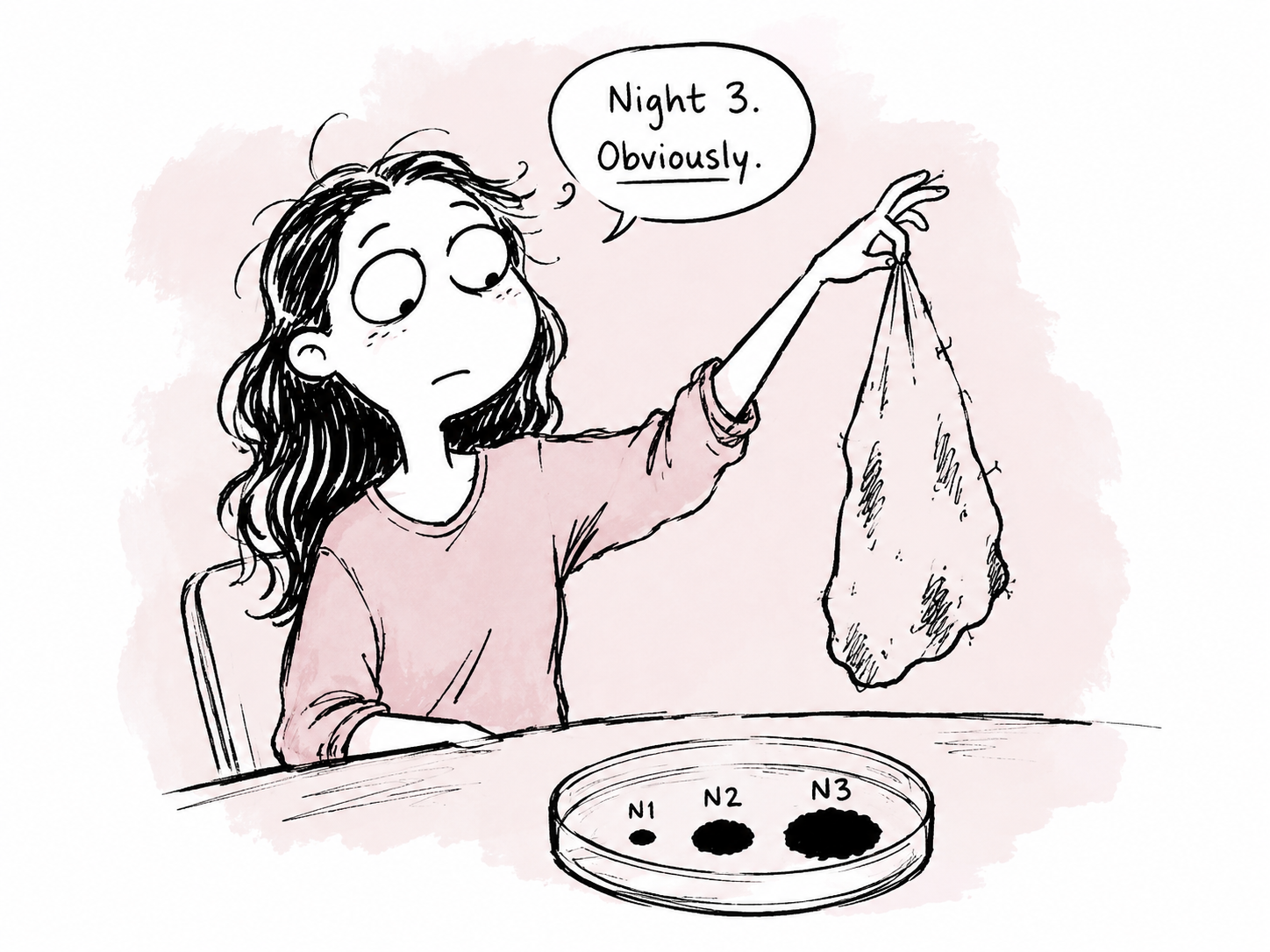
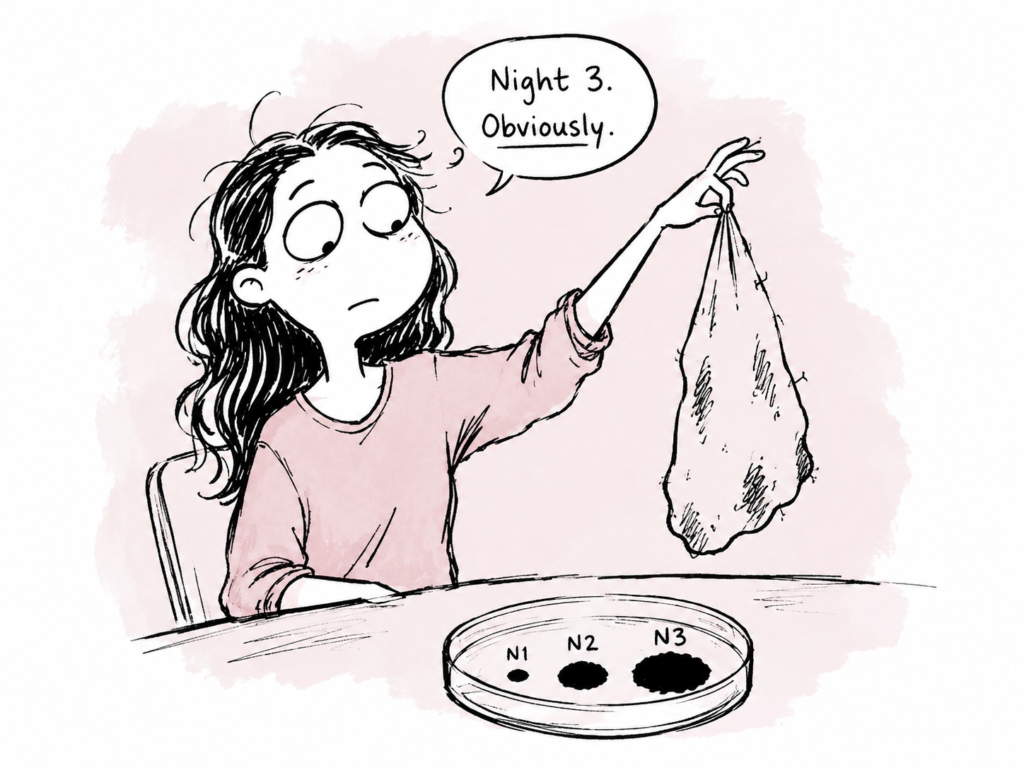
Here’s what happens on night one: you shed roughly 30,000 to 40,000 dead skin cells per hour during sleep. Your sebaceous glands are still active. Hair products, moisturizer residue, and saliva transfer onto the fabric. By night three, your pillowcase has become a selective growth medium — warm, moist, and rich in lipids. That’s precisely the environment where Malassezia thrives.
Malassezia is a lipid-dependent yeast that lives naturally on everyone’s skin. Under normal conditions, it’s a quiet resident. But when it gets a continuous lipid supply — like the oleic acid–rich sebum accumulating on your pillowcase — it shifts from commensal to opportunistic. Think of it like a restaurant that never closes and never runs out of food. The yeast colony doesn’t just survive; it builds.
The contact transfer mechanism is the key piece most people miss. Every night you press your face against that surface for six to nine hours. That’s not brief contact — it’s sustained, warm, occluded exposure. Research on skin microbiome transfer to textiles shows that fabric can retain and re-inoculate organisms back onto skin repeatedly. Your nightly routine strips back surface microbes. Your pillowcase hands them right back.
Bacteria compound the issue. Cutibacterium acnes and Staphylococcus epidermidis also transfer readily to fabric and remain viable for days. A 2021 study in the Journal of Applied Microbiology found that cotton pillowcases showed significant microbial colonization within 48–72 hours of regular use — even after laundering with standard detergent cycles that didn’t hit 60°C.
Your pillowcase isn’t passively dirty — it’s actively reseeding your skin every night.
THREE THINGS TO DO TODAY
1. Change your pillowcase tonight — and set a twice-a-week schedule going forward.
Every 2–3 days is the clinically supported threshold for preventing significant microbial buildup, especially if you have oily skin or apply leave-on products at night. The common “once a week” advice is better than nothing, but it’s still 4–5 nights of recontamination before the reset. If twice a week feels like a lot, buy a few extra pillowcases and batch-wash them. The friction should be logistical, not motivational.
2. Flip your pillowcase on alternating nights if you can’t change it.
One side accumulates oils, cells, and microbes while the other stays relatively clean. Flipping on night two gives you a cleaner contact surface before the full swap. It’s not a substitute for washing — it’s a friction-reducing bridge that cuts recontamination in half.
3. Track which side you sleep on and compare it to where your breakouts appear.
This is the observation step that turns a habit change into actual data. If your recurring breakouts are consistently on one cheek, jaw, or temple — the side you sleep on — your pillowcase is almost certainly in the loop. Note it for a week. If the pattern holds, you have a direct cause-and-effect relationship you can actually act on, rather than continuing to cycle through cleansers and actives looking for an answer that’s been under your face the whole time.
Not sure if your pillowcase is your only trigger?
Skin patterns are rarely one cause. Answer 19 questions and get a full picture of what’s likely driving your breakouts.
Identify first. Treat second.
ONE CLOSING QUESTION
Do your breakouts show up more on one side of your face than the other — and does that side match where you sleep? Drop it below.
REFERENCES
- Callewaert, C., et al. (2021). Characterization of Staphylococcus and Malassezia transfer to textile fabrics during use. Journal of Applied Microbiology, 130(4), 1312–1323.
- Grice, E. A., & Segre, J. A. (2011). The skin microbiome. Nature Reviews Microbiology, 9(4), 244–253.
This content is for educational purposes only and does not replace professional medical advice. Always consult a board-certified dermatologist for diagnosis and treatment.